
I’ve been given the opportunity to take part in a improv workshop in April 2026 focusing on the show Meta, created by the french theatre company La Morsure. This is the perfect opportunity for me to put in order some old notes I’ve jotted down about this famous concept of ‘meta’!
You’ve probably not had the chance to see Meta, the show. But you’ve certainly heard the term used in relation to humour, certain forms of entertainment, or even improv.

You may have heard someone say “that’s so meta”, or perhaps you’ve used the expression yourself. But can you easily explain what “meta” actually means? Not so easy!… It’s a vague concept that seems to apply to a very diverse range of things.
We often talk about ‘meta’ when there’s a frame within a frame – a commentary on the work itself made by an artist or a character who is part of the work in question. But we can also use this expression when we spot a hidden reference that points to a reality outside of the work itself. We’ve spotted the reference, we’ve picked up on a ‘tribute’ or a ‘meta joke’.
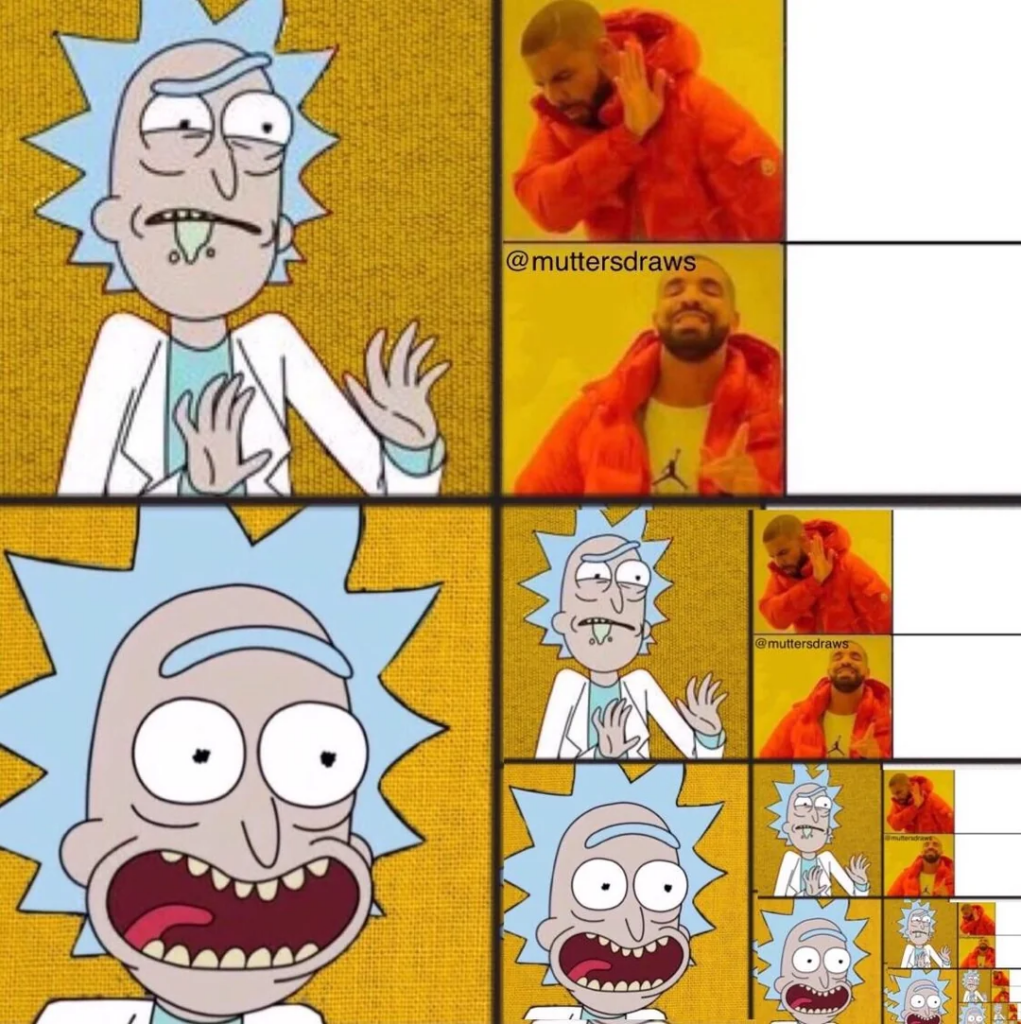
This meta culture is very much present in the memes shared on the internet. Memes rely heavily on an understanding of external references, and ultimately form a vast self-referential network.
But what interests us here is the concept of ‘meta’ as applied to theatre, and more specifically to improvisational theatre.
Let’s start from the basics!
What is ‘meta’?
‘Meta’ is a term of Greek origin: μετά means ‘after, beyond, with’. It is a prefix and even an adjective that can be combined with a whole range of terms to give them a different meaning. This is where it gets complicated, because the term can take on quite diverse meanings.
‘Meta’ can alternatively mean:
- beyond, elsewhere: the term ‘metaphysics’ refers to a branch of philosophy that studies what lies beyond tangible, physical experience: what is the meaning of life, is there life beyond earthly existence, what is the soul, etc… The term ‘metaverse’ refers to a universe distinct from our own, a virtual universe.
- which encompasses subsets: metadata is data that applies to one or more other pieces of data. A meta-analysis is a synthesis of various studies relating to a common theme. Metafiction refers to a story that contains other stories, such as The Arabian Nights, The Princess Bride, The Neverending Story, or House of Leaves. In its original ambition, the META brand created by Mark Zuckerberg in 2021 aimed to encompass a whole range of services to become an essential reference point for our digital life.
- about: Meta-humour is defined as humour that is self-aware of its status as a joke or fiction. The term ‘meta-art’ refers more broadly to self-referential works of art, that is, works that explicitly identify themselves as art and whose primary purpose is to provoke reflection on art itself.
In theatre or cinema, this can take the form of characters who address the audience directly, breaking what is known as the ‘fourth wall’, and who sometimes refer to themselves as fictional characters.
Put more bluntly, meta-art can be defined as an exercise of intellectual masturbation.
Defined in this way, it’s easy to think that ‘meta’ is just a way to spot pretentious wankers!
Well, it can be that, but it can also serve as a foundation for bringing great honesty to one’s art.
To understand all this better, I suggest we take a brief detour into the world of cinema.
Choosing Meta over the Monoform
I’d like to talk to you about the British filmmaker Peter Watkins, who passed away in late 2025, leaving behind a body of work comprising some fifteen movies and short films.
It is likely that you have never heard of Peter Watkins. He was a rather obscure artist, with virtually no critical or commercial success to his name, even though he won an Oscar for Best Documentary Film in 1967. And it is likely that his films will bore you to tears… The themes he tackles are depressing, the angle he takes is very openly militant, the actors and actresses are largely non-professionals, and the last works he produced are epic films lasting over three hours (sometimes even 14 hours!).
His creations are, however, highly original and interesting for the form they choose to adopt.
Peter Watkins has never made a secret of being a fiercely anti-capitalist and anti-imperialist filmmaker. This has resulted in militant films, but also – and this is where it becomes of interest to us – in a fascinating subversion of the format of mainstream Western cinema.
Cinema has been around for just over a century, and its formal conventions are now well established. So much so that we tend to forget which elements are actually the result of highly arbitrary choices… Fiction in modern Western cinema does indeed follow fairly standardised aesthetic codes, established by the influence of the mass media. Peter Watkins called this the ‘monoform’. According to him, it is characterised mainly by ‘rapid flow of changing images or scenes, constant camera movement, and dense layers of sound’. This is obviously a simplification, but the recent evolution of cinematic language seems to prove Watkins right: the average duration of shots has fallen drastically in recent years, with increasingly ‘choppy’ editing in both children’s cartoons and mainstream blockbusters and movies. Music is also very prominent and has become spectacularly standardised in trailers, for example. This form is not without consequences. It encourages the “suspension of disbelief”.
The concept of ‘willing suspension of disbelief’ was introduced by the British writer, critic and poet Samuel Taylor Coleridge. He writes in his Biographia Literaria (1817), an essay on the creation and reading of poetry: ‘[…] It was agreed, that my endeavours should be directed to persons and characters supernatural, or at least romantic, yet so as to transfer from our inward nature a human interest and a semblance of truth sufficient to procure for these shadows of imagination that willing suspension of disbelief for the moment, which constitutes poetic faith”.
According to Coleridge, one believes temporarily in a work of fiction only if its ‘semblance of truth ’ is ‘sufficient’. In modern cinema, the audience’s disbelief is countered with a wealth of formal devices: tight editing that limits the opportunity for stepping back and reflection, and the framing of the emotional interpretation of the narrative through the use of music and close-ups. But that is not all. In cinema, every effort is made to create a ‘semblance of truth ’ and conceal the artifice of fiction: editing, make-up, costumes, sets, special effects… Enormous efforts are made to hide the strings of creation. Everything is therefore done to ensure that the audience’s critical distance is virtually non-existent.
It is this domestication of the audience that Peter Watkins condemns in cinema. But the famous German playwright Bertolt Brecht had formulated a very similar critique of theatrical conventions in his essay A Short Organum for the Theatre (1948), in which he argued for establishing a healthy distancing effect from fiction.
Peter Watkins went on to create films that serve the purpose of distancing. His latest work, the historical film Commune – Paris 1871, combines several artistic methods used throughout his career:
- The use of slower, more drawn-out editing – the director’s cut version runs for 5 hours and 45 minutes
- The predominance of direct sound recording, with no added soundtrack
- The visible use of theatre sets (much like in Lars von Trier’s film Dogville)
- The use of anachronisms: the story of the Paris Commune is told through clips from two television channels (!) – which are, of course, fictional: Commune TV and Versailles TV
- The actors and actresses speak directly to the camera about how they approached their roles and characters
- Certain characters, created specifically for the film, are explicitly described on camera as “entirely fictional characters”
- The team cast non-professional actors and actresses and made extensive use of improvisation and on-the-spot writing, following several months of preparatory documentary research.
All these choices were made to highlight the artificial nature of the endeavour as much as possible. The people we see on screen are actors and actresses re-enacting events. And we are regularly reminded of this. The shifting perspectives (actors and actresses, people on the street, political figures, figures from the various opposing media outlets, etc.) build, over the course of the film, a multifaceted picture that helps viewers take a step back from the events depicted and better grasp the social and individual dynamics at play (the film does, however, favour the perspective of the insurgents).
One might think that this approach results in a cold and boring film. Quite the contrary: certain street scenes or improvised debates are among the most immersive scenes I have ever seen on the big screen. Commune – Paris 1871 is also a work that has allowed me to view all the other movies I have seen in a different light. It was by watching a fictional film shot like a documentary—with voice-over, on-the-ground reporters and characters giving on-camera testimonies (a technique used in many of Watkins’ films)—that I realised the arbitrary and almost deceitful choice made by mainstream fictional movies. They act as if the camera didn’t exist, even though it is, in fact, the most concrete and tangible reality of the process of making a movie…
Watkins’s cinema serves as an example of how the use of a meta-perspective can foster transparency and honesty towards the audience.
But let’s return to theatrical improvisation. How does the meta-perspective manifest itself there?
Theatrical improvisation has always been, and always will be, meta
In his book The Fabulous Science of the Unforeseen (2018), Nabla Leviste explains that artists draw on different facets of their personality when improvising: the ‘person’, ‘who I am in real life’; the ‘actor’, ‘what I am in rehearsal or on stage’, and the ‘character’, ‘what I am during a scene’. These three facets combine during a performance or a workshop.
Nabla explains that this theory of facets was inspired by Jacob Levy Moreno, an Austrian-born psychologist and playwright, who, in his book Theatre of Spontaneity (1947), distinguished between two “states” in an improv actor: the “social” state and the “spontaneous” state.
This distinction between facets is found in the work of other theatre theorists. Michael Chekhov, for example, distinguishes in his book To the Actor (1953)
“three different beings, each with its own character and playing a particular role, relatively independent of the others” These are the “higher self”, which corresponds to the artistic personality and enables a “creative state”; the “everyday self”, which acts as a “moderating element” through “common sense”; and finally, “the awareness of the character created by us”. We clearly see here the three facets defined by Nabla Leviste: “actor, person and character”.
Nabla also points out that there can be many more roles involved, citing those of set designer, trainer, MC, stage manager, artistic director and stage director. Personally, I would add the roles of ‘scriptwriter’ (what story do I want to tell) and ‘citizen’ (what values and beliefs do I want to uphold).
These different roles come into play during the creative process but generally fade into the background behind the character during a theatrical performance. In improv, however, creation and performance happen simultaneously. All these roles must therefore come to the fore at the same time!
With improvisation, there is no ‘fourth wall’: the audience comes to see stories, of course, but also and above all a band of artists who have no idea what is going to happen in the next hour and are creating an entire theatrical performance right before their eyes.
The improv troupe cannot conceal what goes on behind the scenes! Improvisation is a fundamentally meta performance: the audience comes to witness the artists’ endeavour, their risk-taking and their potential mishaps.
That said, an improv troupe can choose to make greater or lesser use of ‘meta’ elements, that is to say, to give performers more or less scope to express themselves as actors, citizens or individuals. And this can be done with varying degrees of success…
The good Meta and the bad Meta

The dark side of meta: opting for irony
As we saw at the start of this article, ‘meta’ can mean ‘above’ or ‘beyond’. The meta stance is, in fact, a tool that can be used to distance oneself from the narrative being played out on stage. The performer no longer embodies a narrative; they comment on it.
Speaking as an artist during the performance allows one to distance oneself from the characters one is embodying, and almost to apologise for what one is presenting to the audience.
The meta-posture is therefore a tool that can be used to produce irony, namely the worst enemy of beauty and emotion on stage.
I’m not going to go on and on here about my hatred of irony. If you’d like to know a bit more, I urge you to read this article (on characters’ first names) or this one (on improvised drama).
I define irony as an approach that consists of laughing at the expense of the characters rather than making the audience laugh through the characters.
An ironic performer mainly relies on double meanings and the implicit language to establish a sense of complicity with the audience against the characters. An ironic artist feels no empathy for their characters, and consequently does not allow the audience to feel empathy for the protagonists of the story. The ironic stance breaks the chain of empathy.
It is a strategy that may be acceptable in certain cases but which quickly proves to be a losing one. On the one hand, this results in an intellectual, potentially interesting line of argument – though all too rarely in improv – and on the other hand, it destroys the emotional connection with the audience.
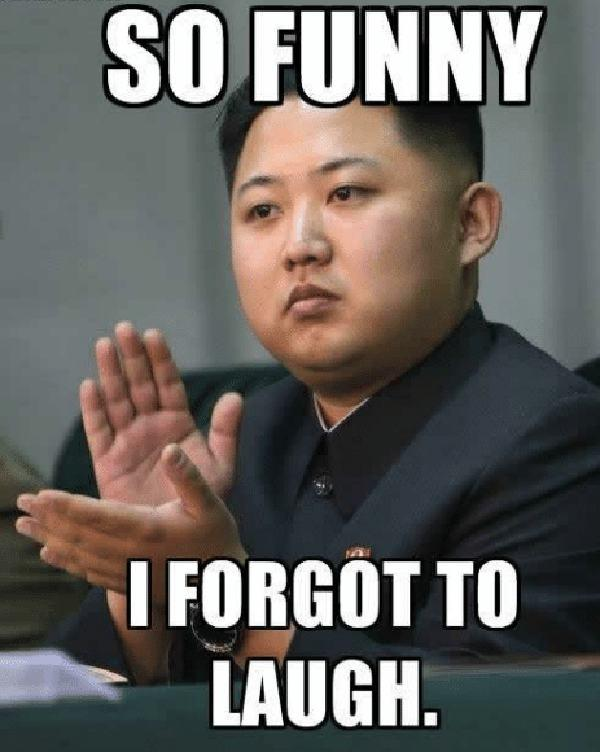
The potentially harmful nature of the meta has already been studied at some length in the fields of role-playing and video games: among role-players and gamers, the term ‘meta’ is used to refer to strategies devised by players using systemic information gathered over the course of their games: players eventually identify the actions their characters can perform to maximise their chances of victory. We refer to it as the meta because the information used relates to the game system and is, in principle, unknown to the characters played by the players. This is why a game that, on paper, offers a very wide variety of actions and tools may see a single, definitive “meta” emerge—that is, a strategy that yields the best results as quickly as possible.
In this case, it becomes apparent that the players have stopped playing—that is, having fun, experimenting, discovering and embodying their characters. They have started working, that is, modelling and deploying a rational method strictly geared towards achieving a goal. Meta is thus often described as anti-play by role-players. The character is no longer an end in itself or a subject; it is an object, a means used to maximise one’s individual performance.
The irony, namely bad Meta, places the artist and the audience in a working posture, rather than a playing posture.
The light side of Meta : empowering artists and audiences
But I certainly don’t intend to end this article on a negative note. Especially not to leave you with misconceptions about the effect of meta.
Whilst there is such a thing as a misuse of meta, fortunately there is also a highly beneficial use of it.
The previous paragraphs on the ironic stance might suggest that the use of meta prevents an emotional connection with the audience. Yet this is not true, as we shall see.
The example of Peter Watkins’ films demonstrates that the use of meta does not necessarily disrupt the audience’s immersion in the story.
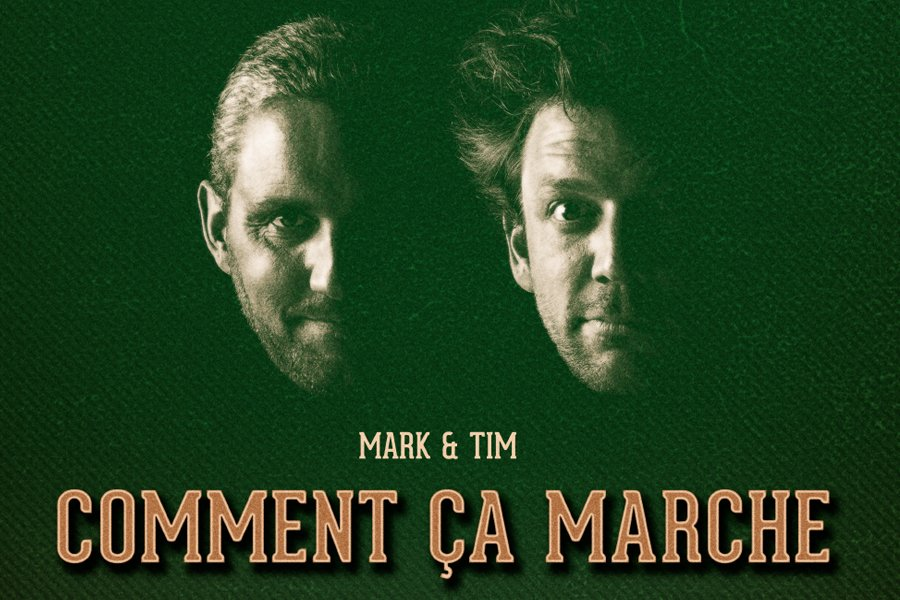
In improv, the Parisian duo Mark Jane and Timothée Ansiaux present a full-length show entitled ‘How does it work’, in which the actors interrupt the unfolding story to share with the audience the tricks of the improvisation trade, and what they are currently doing or preparing.
These meta-interruptions do not prevent them from presenting a story capable of keeping the audience on the edge of their seats for an hour.
More broadly speaking, we are familiar with dramatic techniques that simultaneously result in a loss of realism and a powerful sense of immersion: these are masks and puppets.
A psychosocial study conducted in Finland in 2021 sheds light on the cognitive processes of people who practise improvisation and confirms what these examples illustrate.
In this study, 39 participants took part in two distinct scenarios. In the first, they took part in interviews during which they spoke about themselves, whilst the interviewer belittled them, interrupted them and expressed non-verbal rejection by frowning and looking bored. It is important to note that around half of the participants were informed that the interviewer was an actor, whilst the other half believed they were interacting with a real interviewer. The second part of the study consisted of a 25-minute improvisation session. Here, the participants knew that the social rejections were fictitious, which made the scenarios less emotionally charged than the real interviews.
The most striking finding was that the participants’ psychophysiological markers during the real interviews and the fictionalised improvisation sessions showed significant similarities, even though the participants knew that the rejections were not real. In other words, their brains and bodies reacted in the same way in both scenarios.
Sirke Seppänen, research director, highlighted the importance of this finding, stating: “Regardless of cognitive awareness of fictionality, bodily responses to social rejection in real and fictional contexts were associated and relatively similar. This finding provides biological evidence and empirical support for the use of applied improvisation to simulate social encounters for educational purposes ”.
Chiara Cappelletto, a researcher in theatre studies, explains in an article for the journal Epistemocritique that “the spectator does not react as though what they are seeing were real—ignoring its artificiality—but as though what they see were not feigned, for they recognise in it the original disposition of humankind. From an epistemological perspective, it is not a matter of suspending disbelief in fiction, but of understanding that it is merely the expression of humanity’s ex-centricity towards itself, the realisation of the simulation embodied by certain stage props and architectural structures, such as the mask, the stage frame, etc.”
When actors do not lose the empathy they owe to their characters, a fruitful exchange can be established between artists and spectators.
The audience is then ‘allowed’ to perceive the show’s limitations and flaws; they do not feel ‘compelled’ to admire the work. Indeed, they often participate actively in the creative process alongside the artists.
Their engagement and enthusiasm may be all the more spontaneous if what they are witnessing appeals to them or moves them.
Meta is therefore a fundamental element in the quality of the intellectual and empathetic bond that can be established within the community formed by the artists and their audience. When we perform the show Shitform, we begin to address the audience directly as individuals, as we believe this connection is fundamental to the success of a great performance.

Meta-narrative also serves as a tool for ensuring the emotional well-being of community members. By making the meta-narrative explicit—that is, by highlighting the fictional nature of what is being performed—the collective enables its members to step back and even take action if the themes or actions depicted offend their sensibilities. Meta helps to create a safe space in which to experience situations that would normally prove too distressing.
This can involve interacting with the audience during the performance to clarify the troupe’s intentions, helping them to step back from a story that might be unsettling or whose meaning could be confusing if not explained.
Improvisation lies at the heart of several art therapy practices, such as the one described in the Finnish study cited above. Psychodrama, a therapeutic theatrical method created by Jacob Levy Moreno at the beginning of the last century, is still used today in healthcare settings to help patients with mental health conditions. Meta is used by role-playing game masters to ensure the emotional safety of participants in RPG campaigns.
Méta does more than just protect; it empowers. This is the principle underlying forum theatre, a discipline created by the Brazilian playwright Augusto Boal in the 1960s. Forum theatre is a tool of the ‘Theatre of the Oppressed’, a concept theorised and first put into practice by Boal in the poor neighbourhoods of São Paulo. Non-professional actors, drawn from a community experiencing oppression, improvise and then rehearse a scene lasting a few minutes that illustrates problematic situations of oppression or tension linked to the social, economic and political reality of that community. This scene is then performed in front of the community for whom the message is intended. At the end of the scene, a facilitator known as a ‘joker’ leads the audience in a discussion during which they share their analysis and feelings about what they have seen. The joker then encourages the audience to consider alternatives to the scene and invites members of the audience to take the place of an actor to try out an action that might alter the course of events.
Forum theatre is regularly used in France to tackle issues such as bullying in schools.
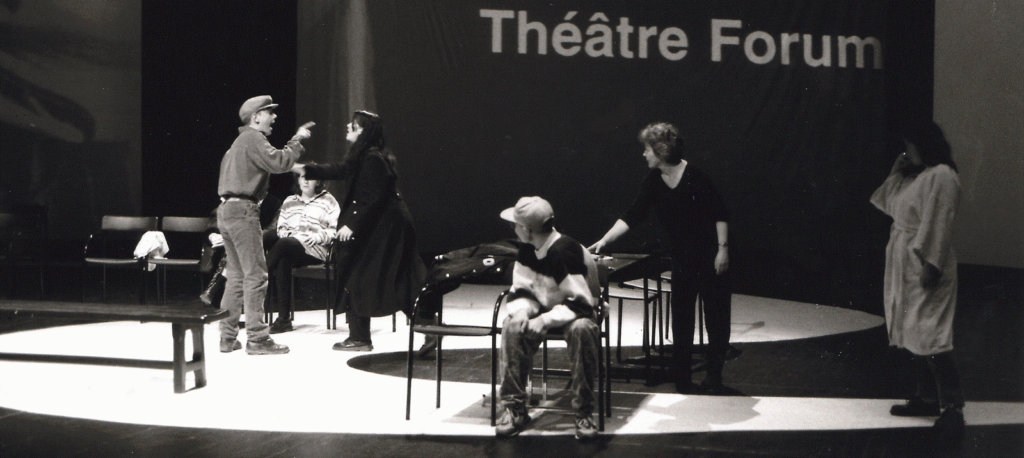
Theatrical improvisation thus helps to realise Bertolt Brecht’s long-held dream: to create a performance that serves the purposes of alienation and emancipation. Meta is political!
Well, thank you for joining me on this exploration of the limits and benefits of the Meta in theatrical improvisation! Perhaps you’ll now view theatre productions, films and TV series in a slightly different light… 😉
References for further reading (in French):
Books :
- Bertold Brecht – A Short Organum for the Theatre (1948)
- Michael Checkhov – To the Actor (1953)
- Nabla Leviste – La fabuleuse science de l’imprévu (2018)
- Christophe Le Cheviller – Canines, carnets d’une improvisation indocile (2025)
Websites :
- Archives des META – La Morsure
- Quatrième mur — Wikipédia
- Métafiction — Wikipédia
- Métagame — Wikipédia
- Qu’est-ce que le metagame ?
- Méta-jeu — Définition JDR
- Le rire méta, élément vital du jdr – L’Averse
- Le méta-jeu, damnation ou rédemption ? | PTGPTB.fr
- Monoforme — Wikipédia
- PeterWatkins -_DarkSide
- Improvisation : renforcer la résilience face au rejet social
- Théâtre et neurosciences : fiction versus naturalisation – Épistémocritique
- Psychodrame — Wikipédia
- Théâtre forum — Wikipédia
- Le Théâtre-Forum | theatredelopprime
Videos :
P.S.
‘Heavy Meta’ is the title of an album released by Ron Gallo in 2017, which I quite liked at the time. That’s all. Love.
Leave a Reply