
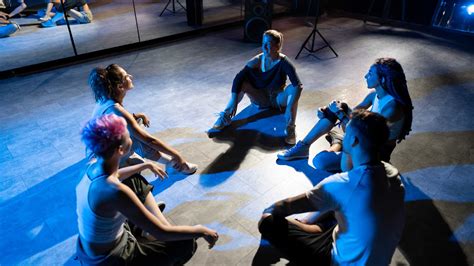
Just five years ago, circles of consent were virtually unknown in the French-speaking improv theatre scene. By 2025, this tool is much better known and fairly widely used within improv groups. That’s something to celebrate!
But like all tools, its use carries risks, which can go as far as mistreating the very people we are trying to protect.
Let’s see how we can make the most of it to best serve our collective practice of improv!
Let’s start with the basics:
What is a circle of consent ?
The circle of consent is a relatively recent practice, inspired by the discussion groups established during sessions of Nonviolent Communication (NVC) or personal development groups.
The aim is to bring together people who are about to practise improvisation together for a workshop or a performance, and to allow everyone to express their boundaries, discomforts or desires, one after the other, without being interrupted.
The circle is often – though not necessarily – facilitated by someone who can keep the conversation flowing, suggest specific topics to discuss, or ask participants to clarify their thoughts.
This tool is particularly useful for highlighting physical boundaries that need to be taken into account (pain or limitations related to a person’s physical condition), agreeing on how to portray moments of intimacy or acts of violence on stage, or determining whether certain themes or approaches make some people uncomfortable.
For example, in a circle of consent, you might share the following information: “My back’s still been playing up since last week, so please be careful not to slap me or try to climb on top of me” / “I don’t kiss on stage” / “I’m not comfortable with stories about grief” / “I love dancing, so if we get the chance to do a dance scene or a choreographed routine, I’d be delighted!”, etc.
What are the expected benefits of a circle of consent ?
The circle of consent serves a dual purpose:
- It allows us to share useful information to prevent any unintended situations of mistreatment or distress during the improv sessions that follow, and to ensure that everyone has a good time. Prevention is better than cure! 🙂
- More broadly, it helps to “foster a culture of consent within the improv community”, as specified in a document published by the Amateur Improv Belgian Federation (FBIA). Regular practice of circles of consent instils habits of consideration and empathy within the groups that use them.
What are the risks associated with circles of consent ?
Like any tool worth its salt, the circle of consent can have drawbacks or pose risks. I’ve identified three, which I’ll outline in order of severity.
- Apparent uselessness
The practice of the circle of consent doesn’t come naturally, especially if you’ve never done it before. It can catch people off guard. In many cases, I get the impression that quite a few participants aren’t quite sure what to share, and simply say “I’m fine with everything”, which is obviously untrue, but the main boundaries they can think of seem obvious to them.
In situations like this, the round of discussion will be of little use for the rest of the workshop or performance. - Reactions of rejection and discouragement
The list of boundaries and topics to avoid can be intimidating for people who come to improv to “not overthink things.”
Several colleagues have told me that participants in their workshops said they felt uncomfortable with circles of consent, because they put them under pressure, forced them to think about everything they had to avoid saying or doing, and this restricted their freedom to play. I’ll set aside comments along the lines of “you can’t say anything anymore”, which mainly reflect the sociological profile of the participants in question (cisgender white men in their forties or older).
The views expressed by these participants remain entirely relevant and deserve to be taken into account by workshop or performance facilitators: a list of things not to say or do can make it harder to let go, which undermines the ability to improvise. - Manipulation of the concept of consent to the detriment of victims.
This is the most serious risk and the one that must be minimised.
This discussion is based on the concept of consent, a concept useful for collective reflection but one that can be misused by those in positions of power by exploiting the ambiguity of the processes associated with it. In a previous article, I discussed the feminist critique of consent, which views it as a potential weapon of patriarchy. For example, an article published on the blog Révolution Féministe highlights that “the consent model focuses the debate almost entirely on what the victim thought or felt, rather than on what the perpetrator did.”
Imagine that a sexual assault takes place on stage and the victim finds the courage to complain about it afterwards to the group. If a circle of consent had taken place before the performance, and the victim had not mentioned the situation that turned out to be problematic, the perpetrator could use this misleadingly to defend themselves: “During the circle of consent you said everything was fine, so don’t tell me now that it makes you uncomfortable when we touch you.”
This is the perfect opportunity to turn the stigma around and cast themselves as the victim instead of the actual one…
How to establish safe and meaningful circles of consent ?
To avoid the pitfalls described above, and to ensure that the circles of consent genuinely foster playfulness, trust and enjoyment on stage, the key point is quite clear: the exercise must be properly contextualised.
How can this be done in practice?
- The circle of consent is a guided process
This practice may not feel natural to people who have never had the chance to get used to it. It is the responsibility of the workshop or performance facilitator to explain the ins and outs of it clearly.
The circle should not be seen as a ‘complicated’ exercise. Ideally, it is introduced as an opportunity to share information that helps us better understand each other’s current state of mind and perform better together. The facilitator can suggest topics that might be discussed, such as physical condition, personal boundaries and discomforts, sensitive issues, or things we’d love to perform. This can give ideas to people who aren’t quite sure what to share.
For participants who say “everything’s fine”, you can ask them if they have any particular ideas or desires for the day’s improv.
For people who might feel stressed by the list of things to avoid, you can reassure them by reminding them that this is primarily just information, and that it’s still possible to make mistakes on stage. Since we’re improvising, we’ll simply be more aware of it if it happens and can adjust more effectively in the moment. So it’s the opposite of a headache, as it prevents misunderstandings and awkward situations on stage!
Support from the facilitator or another designated person is also helpful in empowering performers who do not feel comfortable enough to share their boundaries in front of everyone, as the document published by the FBIA rightly points out: ‘If some people do not feel comfortable but still want to get a point across, they can speak to a representative beforehand (preferably a bench coach, or otherwise the captain), who will convey the message in broad terms, without naming names. Example: “I have players who are not comfortable with the idea of being kissed.” ’
I have found an interesting alternative approach shared on reddit : ‘When a team forms, the coach facilitates a check in where players are asked to close their eyes and put up their hands in answer to the question: “Are you okay with physical touch with clear boundaries. Hands up for yes.” When all players consent to touch, we are a ‘Touching team’, if not everyone consents, we are a ‘No touching team’. We’ve found that if there is a mix, people get confused and stressed out. So it’s easiest to either be touching or no touching. If new players join, or at the request of players, we redo this check in.’ - It is essential to explain the scope of the circle of consent and how consent is approached globally within the group
The circle of consent has no legal binding force. It provides useful information and in no way establishes a ‘consent map’. The facilitator is responsible for discussing the fundamentals of consent with their group: one must remain attentive to one’s performance partners; consent is context-dependent and evolving; what matters most is active listening and respect for others.
The FBIA document also reminds us that “Just because a person has stated their acceptable limits does not mean they must be reached, and the necessity within the story remains essential.”
The circle thus provides an opportunity to share performance principles that ensure dynamic consent management during improv sessions, such as the “80/20” principle: to perform an intimate act on stage (a kiss, a hug, a fight, etc.), the performer who initiates it takes 80% of the initiative, leaving their partner the freedom to perform the remaining 20%. - The circle of consent must form part of a coherent set of tools designed to foster trust and protect all participants
It is not a magic bullet, and no tool is.
In the case at hand, it will only bear fruit if it forms part of a collective effort undertaken by the improvisation group. This effort takes many forms: internal and external communication, training, a charter of values, a code of conduct, internal and external points of contact, spaces for dialogue and reflection, a protocol for collecting testimonies…
For an overview of these various tools, I refer you to the series of articles “OUI ET alors” on this website or the book of the same name. The FBIA has also published its code of values and its online protocol for collecting reports of misbehaviours.
Further Reading (in French) :
- FBIA_Tour-de-consentement.pdf
- FBIA_Chartre-des-valeurs.pdf
- Comportement inaproprié vécu par un membre lors d’une activité FBIA
- Le consentement : un concept piégé – Révolution Féministe
- Les Cercles de Parole – à la base de la démocratie la parole – Groupes, Relation et Non Violence
- OUI ET alors ? – ouvrage
- OUI ET alors ? – articles
Leave a Reply