

(The improv audience – 1/2)
I have written several articles on the importance of looking after our stage partners, particularly when it comes to the issue of consent.
But there was still one major topic left to address, as other partners – and by no means the least important ones – make up the community we form during a performance: the audience!
What is an audience ?
First of all, how should we properly define the ‘audience’? According to the French Larousse dictionary, the term refers to the ‘the population of users of a service’.
The audience would therefore be a gathering of users. We thus tend to view audience members a little too hastily as ‘customers’ who are seeking a service. This overlooks the complexity of the relationships that performing artists forge with the people who come to see them.
As argued in this former article and this book, if we adopt a strictly economic approach, we can indeed consider that the relationship between artists and their spectators is essentially a client/supplier relationship: the spectators pay the artists and expect entertainment in return. But this economic approach is reductive.
Of course, first and foremost, the audience-artist relationship is not one-way: actors perform for the audience, and need the audience’s response to make their work complete and to achieve their full satisfaction as artists.
Wiktionary (French edition) defines the audience more precisely as a ‘group of people interested in an intellectual, literary, artistic, etc. work’. A more ‘active’ definition is beginning to emerge here, but we can take it a step further.
The etymology of the word gives us some clues. In French, audience is spelled ‘public’. Again according to Wiktionary, ‘public’ comes from the Latin noun publicum (‘public interest’), derived from poplicus, which in turn comes from populus (‘people’), with the influence—due to phonetic and semantic proximity—of the word pubes (‘adult’). The audience was thus originally defined as an assembly of adults whose purpose is to represent the common interest. In English, the word ‘audience’ derived from the Latin audientia, which in turn comes from the verb audio (meaning ‘to hear’, but also ‘to understand’ and ‘to accept’). So, it was originally an assembly that listened in order to decide whether or not to accept what was presented to it. We find this original meaning in the legal use of the word in France: the hearings of the Criminal Court, for example, are called ‘audiences’ !
As you can see, the concept of audience has a strong political dimension. And this isn’t absurd if you think about it for a moment: the people who gather in a theatre form a temporary community. This community has come together on the basis of a social contract established by the poster and the show’s pitch: let’s come together to share an aesthetic and emotional experience.
The audience is at the mercy of the performers
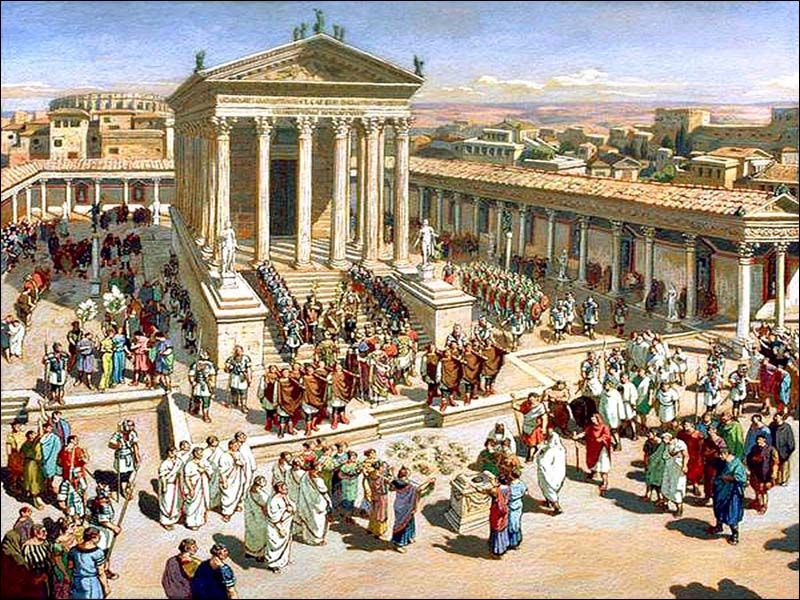
It is important to bear in mind that theatre audiences often find themselves confined to a very passive role: the entire modern theatrical setup (a pitch-black auditorium, seats arranged side by side on a single side of the stage, narrow aisles) forces spectators to remain still during the performance. Spectators cannot see one another (which was the case in ancient forums, and remains so in stadiums and circuses, for example). Because of this ‘fourth wall’ arrangement, spectators also remain constantly in the actors’ line of sight, unlike in circular settings. The movement of spectators is generally restricted (it is not easy to leave the auditorium when seated in the middle of a row). Not to mention that the unspoken rules of conduct stipulate that in the theatre one must respect the moment by behaving as discreet as possible, apart from allowed reactions (laughter, applause). This demand for stillness and silence remains strong, even if we do not like the performance, and worse still if it puts us in a very uncomfortable situation. In short, to use terms specific to improvisational theatre, during the performance, the performers have a ‘high status’ and the audience members have a ‘low status’.
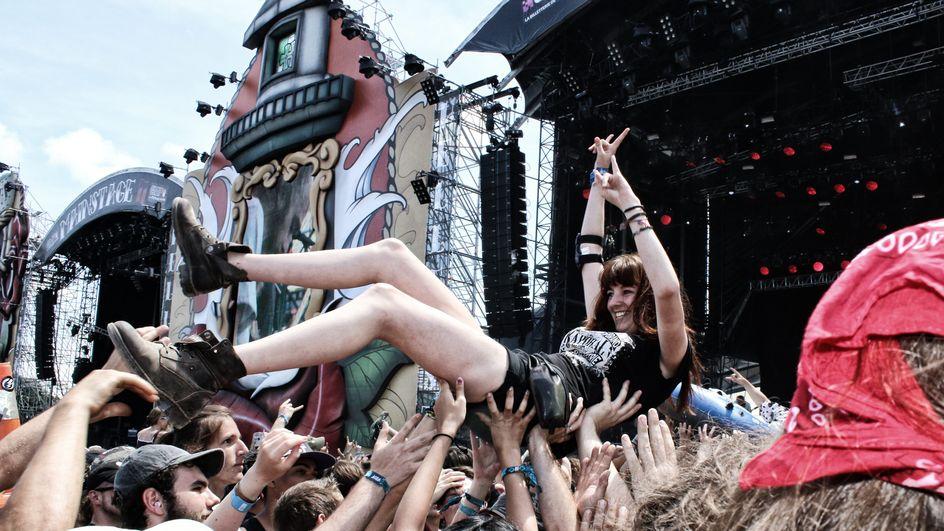
This conditioning is the result of a historical process: the domestication of audiences, which has taken place particularly in the Western societies since the 19th century, in the fields of theatre, dance and opera. By contrast, audiences at popular sporting and musical events have remained far more unruly, active and lively, even if this can be accompanied by other issues such as factionalism and radicalisation. The crowd in a stadium or at a pop concert sings, applauds, whistles, boos, comes and goes to get food and drink, and interacts throughout the event.
If theatregoers do not like the performance, they can walk out of the auditorium in the middle of the show – and this does indeed happen from time to time – but doing so requires an effort on their part. It takes a toll on them, and it is possible that for every person who decides to get up and leave, four others will have silently endured an uncomfortable situation, intimidated by the theatrical setup I described earlier.
Is the audience’s vulnerability different in a scripted show or an improvised one? More festive formats, such as an improv match, certainly encourage the audience to ‘let their hair down’ more and behave less disciplined than in a traditional show. But the layout of the venue and social conventions remain broadly very similar. I would even go so far as to say that the audience’s vulnerability is greater in the context of improvised shows: spectators do, after all, agree to come and see a show whose content or nature they do not know in advance. Is the most impressive ‘leap of faith’ taken by the improvisers or by the spectators? Perhaps by the spectators… After all, the performers have had training workshops, whereas the audience members often come to the performance with no prior experience whatsoever.
On the artists’ responsibility towards their audience
As an artist, one might think that everything that happens in the ‘audience’ seats is entirely the audience’s responsibility. These people chose to come of their own free will; they must accept the emotional and financial consequences.
I feel that this shirking of responsibility is too easy, and carries serious risks of abuse (I explore the concept of mistreatment in this article).
Artists clearly have duties towards their audience! People who come to spend one or two hours in a confined space with a troupe are making a rare and precious act of trust: they are handing over the keys to their emotions and their well-being to the artists without knowing exactly what to expect. In what other area of our lives do we witness such a surrender to strangers? Practically none. In return, artists must not betray the trust that has been miraculously placed in them.
They must take care of the people they welcome into their venue, ensuring they have a good time.
As improv shows are often opportunities for a laugh, one might think that the job is easily done. In reality, it’s far from simple. First and foremost, out of respect for their audience, performers must offer humour that does not belittle groups of people who are already unfairly oppressed. As I pointed out in this article, when we improvise (I mean, when we REALLY improvise), we don’t anticipate what we’re going to say. As a result, particularly when we’re starting out, we tend to fall back by default on clichés, tropes and cultural references that are the norm in our society. Improv scenes thus frequently rely on clichés associated with the dominant social group, and therefore on racist, sexist, homophobic, ageist, ableist, classist, nationalist clichés, and so on… When a troupe performs a scripted show, they can give more thought to its content, refine the text, and spot contradictions or ambiguities. In improv, the risk of misbehaviour is much higher. Of course, there is no need to shy away from humour and spontaneous creation. However, it is necessary to work seriously to produce mindfulness improvisation that undermines the prejudices that many of us have internalised. This is far from trivial, as humour can be a powerful vehicle for oppression.

Artists must be mindful of this, because whilst theatre audiences are already sociologically lacking in diversity, if a company perpetuates oppressive stereotypes, it risks driving away the few ‘non-conforming’ audience members who might have come to see the show. It thus risks homogenising and limiting its audience.
Even assuming that the artists’ experience is sufficient to avoid this pitfall, the risk is not entirely eliminated. It remains possible to shock or upset people in the audience, simply because of the themes that may be addressed on stage, which may be more or less difficult for spectators to accept. It is not so straightforward to tackle subjects such as grief, harassment, sexist and sexual violence, incest and murder in the course of an improv performance without making part of the audience feel uncomfortable.

But how, then, can we prevent the risk of mistreating the audience whilst retaining the wonderful freedom that improvisation offers?
The duty to make one’s cards known
The first principle to bear in mind, I believe, is to be as clear as possible about what we are about to offer the audience. What should the audience expect when they come to see us?
Promotion of the show is essential! It must give a clear idea of the tone of the show and the themes that may be explored.
The pitch must clearly indicate the minimum age for the show and make it clear whether certain themes that some people may find difficult to cope with will be addressed. Yeah essentially ‘trigger warnings’.
I know this is a controversial topic within the performing arts and the arts in general. Should we list every detail of a production, at the risk of spoiling the surprise, watering down the concept, or putting off people who might have benefited from the exploration of certain important themes? The answer is far from straightforward, particularly when it comes to theatrical improvisation. A play that has been written and rehearsed is much easier to pitch than a show where the actors have absolutely no idea what they will actually be performing come the evening of the performance! If an improvised show has no specific theme, theoretically anything could happen on stage. So, what can we announce or plan for? Should we rule out certain themes from the outset, or, on the contrary, highlight a whole range of potential ‘risks’? All of this could either undermine the work or unnecessarily deprive the troupe of an audience that might ultimately have loved the performance.
Moreover, in some cases, the concept of the show may fundamentally rely on surprise, or on a ‘twist’ that one does not wish to reveal in advance.

I know that many artists deliberately seek to catch the audience off guard, refusing to give them what they expect, in order to stir up strong emotions and prompt them to engage in meaningful reflection. It is true that if a troupe makes its intentions clear from the outset, it will surprise its audience less, and if it carries a particular political message (feminist struggle, anti-racism, social justice, environmental protection, etc.), it will only be preaching to the converted. This would seem to argue for a necessary element of surprise.
Mark Jane presented his show entitled ‘Call Me Maybe’ at the 11th ‘Impulsez’ festival in Toulouse. The pitch is as follows: ‘Is it possible to find the perfect person? This improvised romantic comedy follows a character and three of their romantic relationships. Each potential partner has their own flaws and qualities, defined by the audience before the show begins. The audience can even decide who our heroine will choose to, if not spend the rest of her life with, then at least finish the show with, regardless of whether the suitors are terribly flawed. Love isn’t as easy as it seems in Hollywood films.” Skip the following paragraph if you want to avoid spoilers about this show.
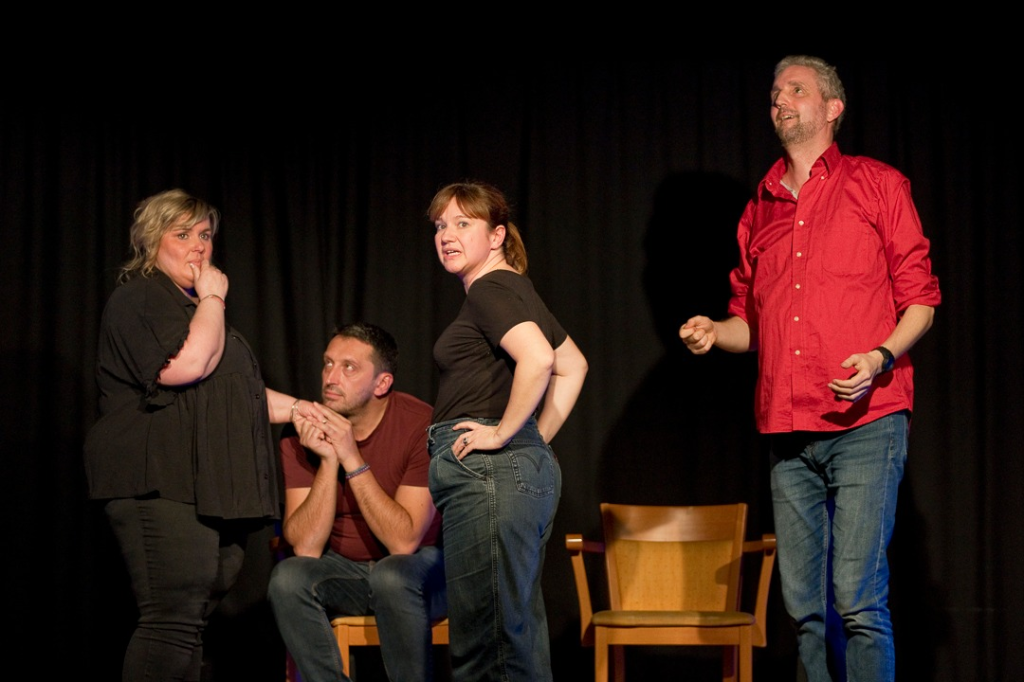
The description sets the tone, but only subtly: this “romantic comedy” is indeed constructed to make the audience viscerally feel the horror of toxic relationships, pushing each character’s flaws to their extreme. Towards the end of the show, Mark asks the audience which person the main character will stay with. Since the three “lovers” have been shown in their darkest and most pathological light, such a choice proves excruciatingly painful. The audience rebels: “None! Run away! Choose to be single again!” they shout at the protagonist. This is precisely the reaction Mark is aiming for. He nevertheless forces the audience to choose, with heavy hearts, between the lesser of two evils. The show ends on a rather bitter note: hell is other people… So, it’s far from the rom-com some audience members imagined they were coming to see. This show could reveal to be a shock to them. That’s precisely the creator’s aim: to chip away at the “romantic lie” and encourage to develop a critical distance from the tropes of mainstream cinema and sentimental novels. Is it worth it? Opinions are sure to be divided.
Every artist must ask themselves the question: to what extent are we prepared to take the audience by surprise, and which potential lesser evil do we choose: prioritizing the safety of the spectators at the risk of becoming too consensual, or prioritizing a strong message / a powerful emotion at the risk of mistreating some sensitive people?
There is no magic bullet, and I wouldn’t presume to name “the” right option, especially since the context is specific to each show and plays a major role in the decision.
Personally, I see two main options available to a group of improv performers:
- Plan to present a show suitable for all audiences (I’ll come back to this);
- Clearly announce if you plan to present material that may be disturbing to sensitive individuals, or suitable only for a certain age group/mature audience. This is the approach taken, for example, by the show “NSFW,” which specifically addresses shocking themes and was only scheduled for late evening performances for audiences over 18. But we can also think of shows that explicitly feature horror stories or that announce they will explore specific themes (mental health, feminist struggles, eco-anxiety, etc.).

This doesn’t end the debate mentioned earlier. I know that many of my colleagues believe that a good work should challenge consciences, provoke aesthetic, intellectual, and moral shocks. I can’t settle this debate; I can only offer my perspective at the time of writing this article. First, I think that one can only usefully challenge people who are already open to being challenged, otherwise it risks provoking rejection and reactance, which I don’t find particularly fruitful. Second, I think that one can go further or less far depending on the characteristics of the audience targeted by the potentially “shocking” content. It seems less problematic to me to “shock the bourgeoisie” (that is, to upset people enjoying a high degree of comfort and security) than to “shake up the vulnerable” (that is, to attack people who are mentally fragile and/or suffer oppression or mistreatment within their social environment). But this already presupposes a good understanding of the composition of one’s audience…
Adapt your show to your audience
Let’s return to the “suitable for all audiences” option I mentioned earlier. It’s the most common, but ultimately the most difficult to define. What do we mean by “suitable for all audiences”? A family audience, an audience that “just wants to have a laugh”? Something else entirely? The definition isn’t clear, and in fact, the audience profile can be radically different from one night to the next.
Should we perform as if there were children in the audience even when there aren’t? In my opinion, no. What we offer on stage should ideally take into account the audience we’re performing for.
In improvisation, the audience should not only be considered an external factor, a constraint, or a framework for the performance. The audience is the artists’ partner in the performance. It is therefore important to know them as well as possible. Several options are available to the artists: taking a quick look from the wings, being present in the auditorium when the audience arrives, gathering information during the booking process, chatting with the audience at the beginning of the show or while waiting in line at the box office, etc.
Any information will help fine-tune the tone of the show. What is the age range of your audience? Their seating arrangement? Their skin color? Their social background? All of this can be deduced from simply observing the audience. More precise information can be gathered by talking with the audience: what are their desires? Their limits? What is their energy level? All of this can be clarified by properly preparing people at the beginning of the show, that is, by making them feel comfortable, explaining what will follow, specifying their options for influencing the content of the show, and giving them the opportunity to express their wishes and boundaries. If a company has defined an artistic direction that may not resonate with some people, it can offer them the opportunity to leave the theatre on good terms (without judgment, with a guaranteed refund, for example). It can also tailor the experience it offers to each individual audience. For example, the troupe Les Imparfaits improvises sketches based on discussions with people in the audience. The artists begin their performance by asking if anyone minds being indirectly represented in comedic scenes, and assuring them that if they raise their hand, they will be “left alone” for the rest of the show.
Sometimes the troupe doesn’t have the opportunity to get to know its audience better or to interact properly with them. In this case, the recommendation is simple: assume that children are in the audience and that, overall, people have come to relax and have a good time, which will influence what the performers feel comfortable doing on stage.
A respected and valued audience will feel much more at ease interacting with the performers! And isn’t that what an improv troupe dreams of doing? Interacting with the audience in the most beautiful and profound way possible. But that’s another story…
This series on the improv audience isn’t over. A future article will address a central question in improvisation: what power should be given to the audience?
Leave a Reply